报告人:Prof. Jae-Hun Jung
时间:2026年4月17日(星期五)13:00-14:00
形式:闵行校区数学楼401/线上直播
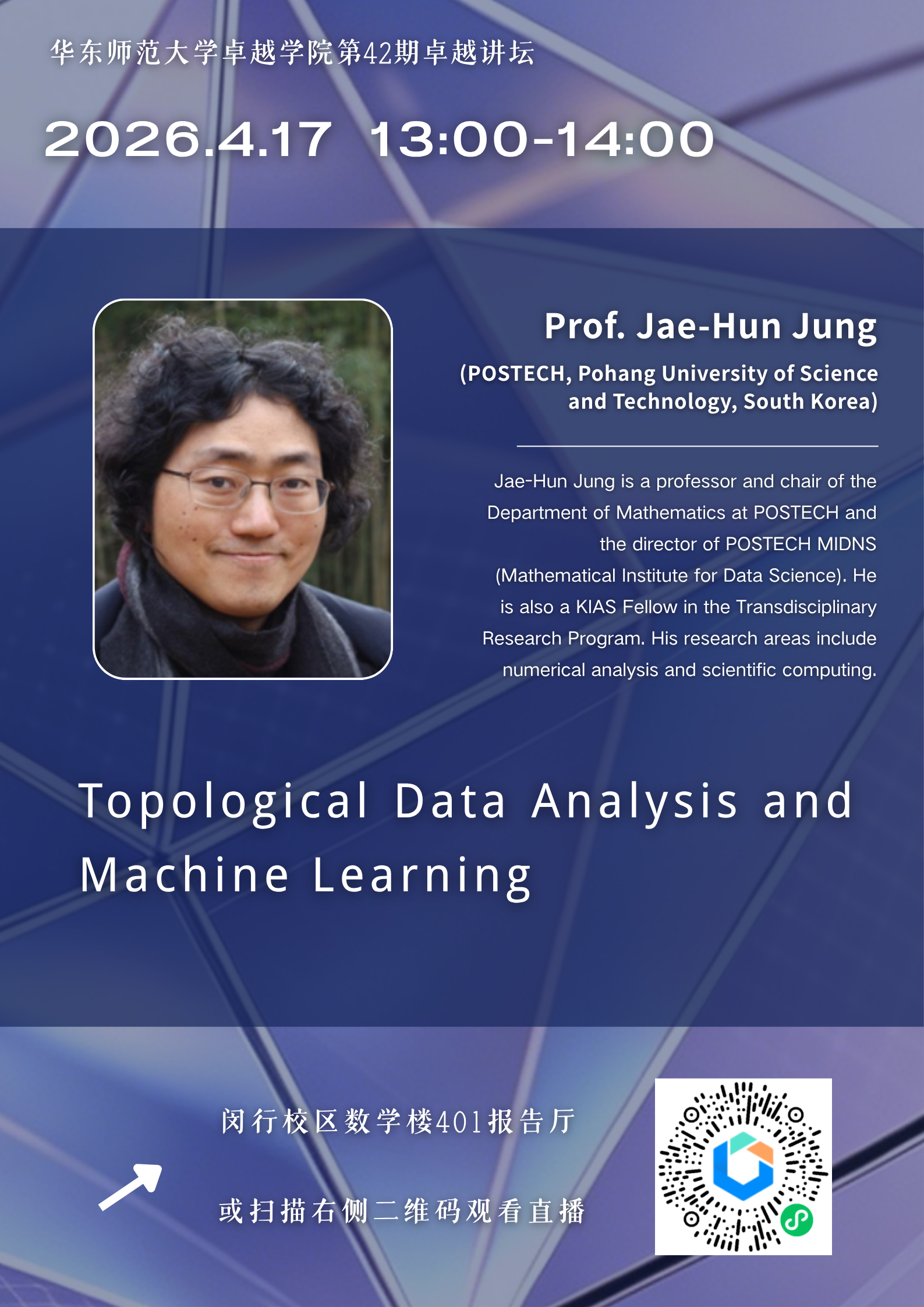
报告题目:Topological Data Analysis and Machine Learning
报告专家简介:Jae-Hun Jung is a professor and chair of the Department of Mathematics at POSTECH and the director of POSTECH MIDNS (Mathematical Institute for Data Science). He is also a KIAS Fellow in the Transdisciplinary Research Program. His research areas include numerical analysis and scientific computing, particularly high-order numerical methods for partial differential equations, including hyperbolic conservation laws. Recently, his research has expanded to the topological analysis of complex data, applying topological methods to applications, including physics, biomedical data, music data, and machine learning and artificial intelligence. Before joining POSTECH in 2020, he held faculty positions at several institutions, including the State University of New York at Buffalo and the University of Massachusetts Dartmouth. He received his Ph.D. from Brown University and was also a PIMS Postdoctoral Fellow at the University of British Columbia.
报告内容简介:Modern data analysis increasingly deals with complex, high-dimensional, and structured data arising from various applications. Traditional methods often rely on local features, which can fail to capture the global structure of data. In contrast, topology provides tools to study the intrinsic shape of data, studying patterns that are robust under noise and deformation. In this lecture, we explain topological data analysis (TDA), focusing on persistent homology as a key method for extracting multi-scale topological features such as connected components, loops, and higher-dimensional structures. We explain how persistence homology summarize these features and discuss their stability and interpretability. We then explain how these topological information can be integrated into machine learning framework. Applications include analyzing the geometric structure of image data, understanding feature representations in neural networks, and capturing semantic organization in large language models. The goal of this lecture is to provide an accessible introduction to the role of topological methods in data analysis and in machine learning framework.
观看方式:拔尖计划2.0全国线上书院直播